
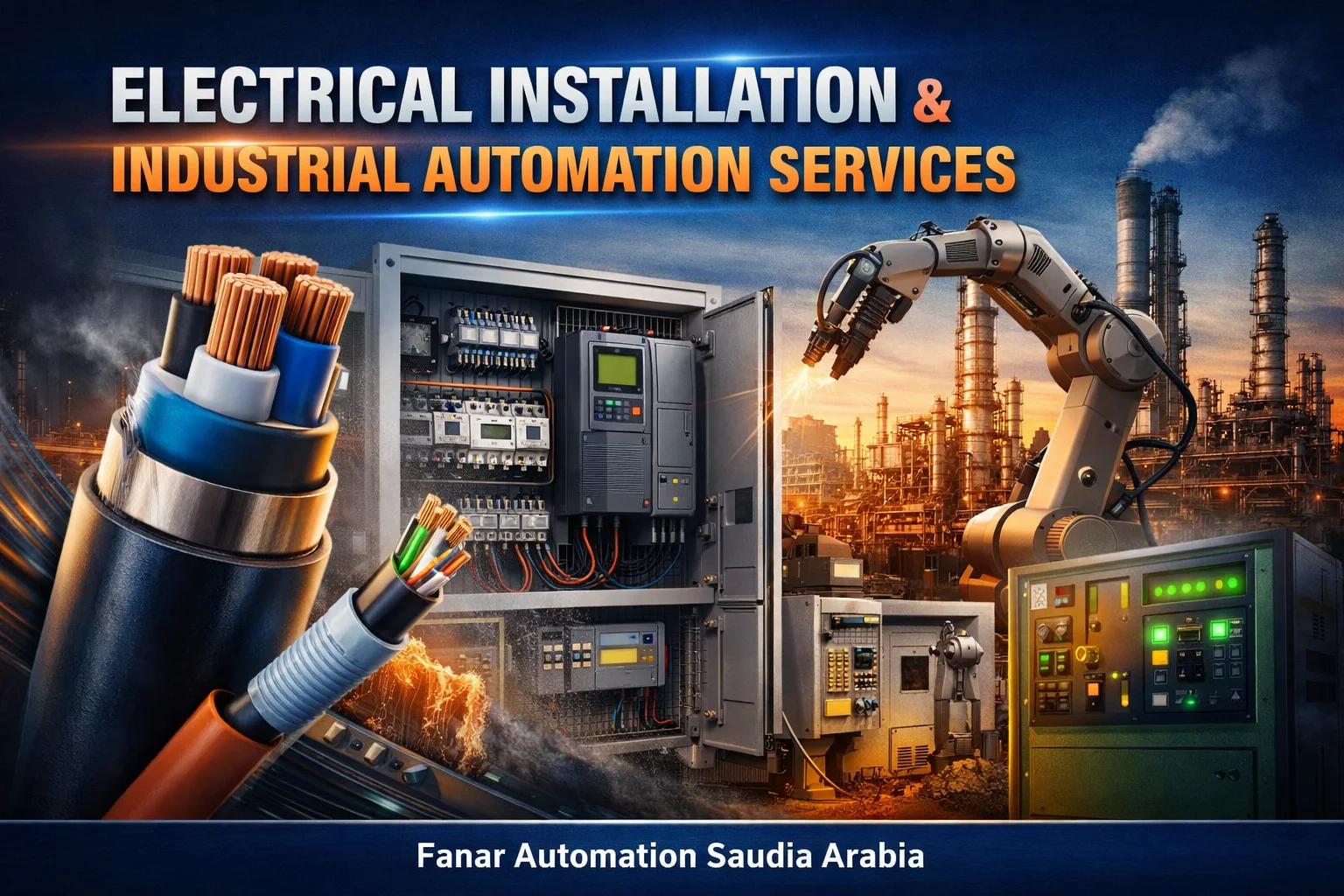
Our Service Range

Electrical Installation Services

We provide complete electrical installation services including:

  • Cable installation and routing
  • Electrical panel installation and upgrades
  • Low and medium voltage system design
  • Equipment installation and commissioning
  • System integration and optimization
  • Safety system implementation

Industrial Automation Services

Our automation expertise includes:

  • Variable Frequency Drive (VFD) installation and repair
  • Control system design and implementation
  • Equipment automation integration
  • Efficiency optimization systems
  • Monitoring and diagnostic systems
  • Process automation solutions

Why Choose Fanar Automation?

Extensive Experience

Our team brings:

  • Over 5 years of proven experience
  • 200+ successfully completed projects
  • 96% client satisfaction rating
  • Expertise in diverse industrial sectors
  • Track record of delivering complex solutions

Quality Assurance

We ensure:

  • SASO standard compliance
  • Professional workmanship
  • Complete testing and verification
  • Comprehensive documentation
  • Warranty-backed services

Expert Team

Our professionals include:

  • Licensed and certified electricians
  • Specialized automation technicians
  • System design engineers
  • Project managers
  • Support and maintenance specialists

Our Products and Solutions

Electrical Products

  • Circuit breakers and protective devices
  • Distribution boards and panels
  • Cables and cable accessories
  • Industrial plugs and connections
  • Low-voltage and medium-voltage equipment
  • Power factor correction systems
  • Backup power solutions

Specialized Solutions

  • Pump panel systems for agricultural applications
  • Oil and gas industry solutions
  • High-reliability industrial systems
  • Safety-critical applications
  • Custom-designed solutions

Service Coverage

We serve all of Saudi Arabia with:

  • Responsive service delivery
  • Local technical support
  • 24/7 emergency services
  • Scheduled maintenance programs
  • Preventive maintenance plans

Project Success Stories

Our portfolio includes:

  • Large-scale industrial facility upgrades
  • Critical power distribution systems
  • Specialized automation implementations
  • Complex cable management solutions
  • High-reliability industrial systems

Our Commitment to Excellence

Safety First

Every project prioritizes:

  • Worker safety
  • Equipment protection
  • System reliability
  • Code compliance
  • Best practices

Customer Service

We deliver:

  • Professional consultation
  • Clear project timelines
  • Transparent pricing
  • Regular communication
  • Post-project support

Continuous Improvement

We maintain:

  • Current certifications and training
  • Latest technology knowledge
  • Industry standard awareness
  • Quality improvement initiatives
  • Customer feedback integration

From Concept to Completion

Initial Assessment

  • Detailed site evaluation
  • Current system analysis
  • Requirement gathering
  • Design consultation
  • Budget estimation

Design and Planning

  • System specifications
  • Equipment selection
  • Installation planning
  • Safety system design
  • Timeline development

Professional Installation

  • Proper equipment installation
  • Code-compliant execution
  • Rigorous testing
  • Documentation creation
  • System optimization

Ongoing Support

  • Maintenance services
  • Emergency response
  • Equipment upgrades
  • Performance monitoring
  • Preventive maintenance

Industrial Applications

We serve:

  • Manufacturing facilities
  • Processing plants
  • Oil and gas operations
  • Utilities and power distribution
  • Commercial facilities
  • Agricultural operations

Specialized Expertise

VFD Services

  • Installation and commissioning
  • Troubleshooting and repair
  • Performance optimization
  • Maintenance programs
  • Component replacement

Panel Services

  • Design and manufacturing
  • Installation in various environments
  • Upgrades and modifications
  • Maintenance and repair
  • System integration

Cable Services

  • Complete installation solutions
  • High-current applications
  • Environmental protection
  • Maintenance support
  • System documentation

Technology and Equipment

We use:

  • Modern diagnostic equipment
  • Advanced testing tools
  • Quality materials and components
  • Industry-standard practices
  • Documentation systems

Flexible Service Options

  • Project-based services
  • Maintenance contracts
  • Emergency response services
  • Consultation services
  • Training programs

Cost-Effective Solutions

Our approach delivers:

  • Efficient project execution
  • Reduced downtime
  • Long-term reliability
  • Operating cost optimization
  • Value for investment

Getting Started with Fanar Automation

Ready to discuss your electrical and automation needs?

Contact Information:

  • Phone: 539 445693
  • Email: info@fanarautomation.com
  • Address: Office 21, second floor, Al-Salouli Building, Abdullah Hamadhani Street, Al-Malaz District, Riyadh 12629, Kingdom of Saudi Arabia

Service Hours:

  • Monday-Thursday: 8:00 AM – 5:00 PM
  • Friday-Saturday: Closed
  • Sunday: 9:00 AM – 4:00 PM
  • Emergency services available 24/7

Why Fanar Automation Sets the Standard

In Saudi Arabia’s competitive electrical services market, Fanar Automation distinguishes itself through:

  • Proven track record of success
  • Commitment to safety and quality
  • Professional and responsive team
  • Comprehensive service offerings
  • Customer-focused approach
  • Competitive pricing

Choose the Leader in Electrical and Automation Services: 539 445693 | info@fanarautomation.com

Reason 1: Safety Expertise and Compliance

Professional installers bring:

  • Extensive knowledge of safety requirements
  • Understanding of electrical hazards
  • Use of safety equipment
  • Adherence to code requirements
  • SASO standard expertise

Safety first – professionals provide safe work that protects you and your property.

Reason 2: Sizing and Design

Professionals determine:

  • Wire size for amperage
  • Appropriate insulation for conditions
  • Proper voltage drop calculations
  • Future capacity planning
  • Thermal derating requirements

Undersized cables overheat, fail and pose fire risks. Professionals get it right the first time.

Reason 3: Quality Workmanship

Professional installation includes:

  • Proper handling and storage
  • Correct laying techniques
  • Appropriate protective measures
  • Quality terminations and connections
  • Complete documentation

Good workmanship increases the system’s lifespan and improves its performance.

Reason 4: Comprehensive Testing

Following installation, contractors:

  • Continuity testing
  • Insulation resistance testing
  • Load testing
  • Thermal imaging
  • Performance verification

Testing ensures the system is operational before placing it into use.

Reason 5: Time Efficiency

Professionals complete installations:

  • Quicker than a DIY job
  • With minimal operational disruption
  • Using efficient techniques
  • With proper scheduling
  • Meeting project deadlines

Time equals money. Professional efficiency saves both.

Reason 6: Problem Prevention

Experienced professionals:

  • Anticipate potential issues
  • Design systems to prevent failures
  • Install with maintenance in mind
  • Document thoroughly
  • Build in redundancy

Risk prevention is cheaper than failure.

Reason 7: Warranty and Accountability

Professional services provide:

  • Workmanship warranties
  • Parts guarantees
  • Performance assurance
  • Legal liability protection
  • Recourse for problems

Peace of mind comes with accountability

Additional Benefits

Cost Savings

Although professional services are more expensive:

  • Lower failure rates save time and money
  • Installation prolongs system life
  • Performance enhancements lower energy use
  • Prevents expensive damage to equipment
  • Avoids costly rework

Insurance and Liability

Professional installation:

  • Satisfies insurance requirements
  • Prevents liability lawsuits
  • Ensures code compliance documentation
  • Provides legal protection
  • Simplifies claims processes

System Reliability

Professional installations deliver:

  • Consistent performance
  • Reduced unexpected failures
  • Predictable maintenance schedules
  • Optimal energy efficiency
  • Operational confidence

Common Professional Mistakes to Avoid

When engaging professionals, make sure they:

  • Are properly licensed and insured
  • Offer references and portfolio
  • Offer written warranties
  • Give detailed quotes
  • Provide timeline estimates
  • Include testing in service

Making Your Decision

  1. Complexity of your installation
  2. Safety implications
  3. Long-term cost analysis
  4. Warranty and support needs
  5. Professional availability
  6. Reference reviews
  7. Insurance and liability protection

Fanar Automation’s Professional Services

  • Extensive expertise in cable installation
  • Complete SASO compliance
  • Testing and verification
  • Comprehensive warranties
  • Ongoing support services
  • Professional accountability

Saudi Arabia-Specific Considerations

Climate Challenges

The climate in Saudi Arabia poses challenges:

  • High temperatures (50°C+ degrees)
  • Low humidity affecting static electricity
  • Dust and sand intrusion
  • UV radiation exposure
  • Temperature cycling effects

Temperature Impact on Cables

High temperatures affect:

  • Cable insulation properties
  • Ampacity (current-carrying capacity)
  • Connection reliability
  • Long-term durability
  • Safety margins

Saudi Arabian Standards

SASO Requirements

Standards of Saudi Standards, Metrology, and Quality Organization (SASO) regulate:

  • Electrical installation specifications
  • Safety requirements
  • Testing and inspection procedures
  • Material specifications
  • Workmanship standards

Key SASO Standards

  • Code of Practice for Low and Medium Voltage Installations
  • Safety of electrical equipment
  • Cable specifications and testing
  • Installation procedures
  • Professional qualification requirements

Cable Selection for Saudi Arabia

Cable Types

  • PVC cables: For indoor, moderate environment
  • XLPE cables: For demanding outdoor conditions
  • Armored cables: For mechanical protection
  • UV-resistant cables: For outdoor use
  • Heat-resistant cables: For high-temperature environments

Sizing Calculations

Cable sizing takes into account:

  • Current requirements
  • Maximum voltage drop (3%)
  • Derating for temperature
  • Future expansion capacity
  • Safety factors

Derating Factors

In the Saudi climate, cables must be derated:

  • Tables are based on 30°C ambient
  • Derate for temperatures above 50°C
  • Underground cables are naturally cooled
  • Sufficient spacing for ventilation

Installation Methodology

Site Preparation

  • Survey and mapping
  • Route planning
  • Conduit and support installation
  • Safety measures
  • Utility coordination

Cable Laying

  • Proper handling and storage
  • Appropriate laying techniques
  • Adequate support intervals
  • Proper bend radius
  • Cable identification

Protection Measures

  • Mechanical protection
  • Weather protection
  • UV protection
  • Corrosion protection
  • Thermal management

Connection and Termination

  • Proper joint methods
  • Termination standards
  • Grounding connections
  • Testing procedures
  • Documentation

Safety Considerations

Personal Protection

  • Appropriate PPE
  • Awareness of potential risks
  • Knowledge of electrical safety
  • Proper tool usage
  • Heat management

Equipment Safety

  • Cable overheating
  • Voltage drop issues
  • Mechanical damage
  • Environmental damage
  • Fire hazards

Testing and Inspection

Pre-Installation Testing

  • Cable quality verification
  • Insulation resistance testing
  • Visual inspection
  • Documentation review

Post-Installation Testing

  • Continuity testing
  • Insulation resistance testing
  • Load testing
  • Thermal imaging
  • Performance verification

Inspection Schedule

  • Immediate post-installation
  • 30-day follow-up
  • 6-month inspection
  • Annual maintenance
  • As-needed assessment

Environmental Considerations

Outdoor Installation

  • UV-resistant materials
  • Weather-resistant conduit
  • Proper drainage design
  • Thermal management
  • Regular maintenance

Underground Installation

Underground cables need:

  • Adequate depth (at least 60cm)
  • Suitable ducting
  • Cable markers
  • Drainage provisions
  • Access points for maintenance

Industrial Environments

  • Chemical-resistant cables
  • Fire-rated options
  • Heavy mechanical protection
  • Specialized conduit systems
  • Enhanced safety measures

Maintenance and Longevity

Regular Maintenance

  • Visual inspections
  • Thermal monitoring
  • Cleaning procedures
  • Connection verification
  • Documentation updates

Expected Lifespan

  • Indoor cables: 30-50 years
  • Outdoor cables: 15-25 years
  • Underground cables: 20-40 years

Cost Factors in Saudi Arabia

  • Cable type and quality
  • Installation complexity
  • Site accessibility
  • Environmental conditions
  • Labor availability
  • Material costs

Fanar Automation’s Installation Services

  • Complete site assessment
  • Proper system design
  • SASO-compliant installation
  • Testing and verification
  • Maintenance support
Cable Installation in Saudi Arabia: 539 445693 | info@fanarautomation.com

Residential Cable Installation

Characteristics

  • Lower voltage (120/240V single phase)
  • Thinner wire (usually 12-14 AWG)
  • Limited current requirements
  • Basic circuit organization
  • Simpler safety requirements

Common Applications

  • Household lighting
  • Outlet circuits
  • Appliance connections
  • HVAC systems
  • Water heater circuits

Installation Standards

  • Compliant with National Electrical Code (NEC)
  • Local building codes
  • Typical conduit requirements
  • Standard breaker ratings
  • Standard safety protocols

Safety Considerations

  • Arc flash risk: minimal
  • Voltage hazards: moderate
  • Fire risk: moderate (with correct installation)
  • Grounding requirements: single-point

Industrial Cable Installation

Characteristics

  • High voltage systems (3-phase 277V to 480V+)
  • Thicker wire (1-4/0 AWG or greater)
  • Higher current requirements
  • Complex circuit organization
  • Rigorous safety requirements

Common Applications

  • Motor circuits
  • Large equipment power distribution
  • Control systems
  • Backup power systems
  • Machinery circuits

Installation Standards

  • SASO and international standards
  • Comprehensive design specifications
  • Specialized conduit requirements
  • Heavy-duty breaker ratings
  • Extensive testing requirements

Safety Considerations

  • High arc flash risk
  • Severe voltage hazards
  • Fire risk: significant without proper measures
  • Complex grounding systems
  • Extensive PPE requirements

Comparative Analysis

Voltage Differences

Aspect Residential Industrial
Voltage 120/240V 277V-600V+
Phase Single Three-phase
Current 15-200A 100-3000A+

Cable Gauge Selection

Residential uses lower gauges (smaller diameter) for lower current loads, industrial uses larger gauges for speed and safety.

Conduit and Protection

  • Residential: Plastic or metal conduit
  • Industrial: Large conduit, cable trays, massive grounding

Installation Environment

  • Residential: mostly indoors, dry conditions
  • Industrial: harsh conditions, extreme temperatures, chemicals

Technical Considerations

Load Calculations

Both need load calculations:

  • Residential: simpler methodology
  • Industrial: advanced calculations, such as motor starting loads

Voltage Drop Analysis

  • Residential: typically 3% allowable
  • Industrial: stricter requirements due to equipment sensitivity

Thermal Management

  • Residential: minimal concerns
  • Industrial: important for high-current loads

Safety Protocol Differences

Arc Flash Hazards

Residential: very low arc flash hazard

Industrial: high risk of arc flash incidents involving:

  • Arc flash studies
  • PPE requirements
  • Warning labels
  • Training protocols

Grounding Requirements

  • Residential: single grounding electrode
  • Industrial: multiple point grounding electrodes

Testing and Inspection

Residential: continuity testing

Industrial: extensive testing including:

  • Insulation resistance testing
  • Load testing
  • Thermal imaging
  • Power factor analysis

Cost Implications

Industrial installations are more expensive because:

  • Larger, more expensive cables
  • Complex design requirements
  • Specialized installation techniques
  • Enhanced safety systems
  • Extensive testing

When to Install – In-plant vs. Out-plant

Consider:

  • Equipment voltage and power requirements
  • Safety regulatory requirements
  • Future expansion needs
  • Environmental conditions
  • Operational demands

Fanar Automation’s Installation Services

We offer expertise in:

  • Residential and industrial cable installation
  • Proper system design
  • Code-compliant implementation
  • Complete testing and verification
  • Ongoing support

Optimizing Industrial Operations: The Role of Effective Cable Management

Ensuring operational continuity for the Saudi Arabian industrial sector.

Overview

One of the most expensive problems facing industrial operations today is factory downtime. A significant fraction of these interruptions is a direct result of poor cable management systems. At Fanar Automation, we recognize that effective cable management is critical in ensuring continuous operations across the industrial landscape of Saudi Arabia.

The Importance of Cable Management

Managing cables is about more than just aesthetics. It is a fundamental operational strategy that directly impacts:

  • Regulatory and safety compliance: Meeting strict local and international standards.
  • Equipment life and functionality: Reducing unnecessary wear on hardware.
  • Troubleshooting speed: Decreasing turnaround time when electrical problems arise.
  • System reliability: Lowering the chance of electrical malfunctions.
  • Occupational security: Creating a safer environment for all facility personnel.

Common Cable Management Problems

Many factories encounter persistent difficulties that hinder productivity, including:

  • Disarranged and tangled cables that delay fault identification.
  • Excessive cable tension resulting in untimely wear and tear.
  • Inadequate or inconsistent labeling procedures.
  • Restricted airflow leading to cable overheating.
  • Difficulty accessing specific cables during routine servicing.

Solutions Provided by Fanar Automation

Professional Cable Organization

Our highly trained technicians implement systematic labeling, color-coding, and routing solutions designed to simplify maintenance and drastically reduce troubleshooting time.

Preventive Maintenance Plans

We develop routine inspection procedures to detect potential issues early, preventing them from escalating into costly downtime.

High-Quality Cable Solutions

We supply premium cables and accessories specifically engineered to withstand the unique environmental conditions and rigorous demands of Saudi Arabian industries.

Expert Installation Services

Our certified electricians ensure all installations adhere strictly to international safety standards and best practices.

The Advantages of Professional Management

By investing in a managed cable infrastructure, facilities can expect:

Benefit Impact
Maintenance Efficiency Reduction in maintenance time by up to 40%
Safety Enhanced adherence to industrial safety protocols
Equipment Longevity Prolonged life span of critical machinery
Documentation Improved traceability and system documentation
Emergency Response Increased speed of response during critical failures

Partner with Fanar Automation

Reach out to our expert team for a thorough analysis of your facility’s cable management requirements. We provide tailor-made solutions designed to suit your specific operational needs and budget.

Get in Touch with Fanar Automation Today:

Phone: 539 445693

Email: info@fanarautomation.com

In the world of high-pressure industrial manufacturing of 2026, the word downtime can be found at the top of the dictionary as the most expensive word. In the case of a factory in Dammam or an automated plant in Jeddah, one hour of a halted production could cost tens of thousands of Riyals.

As most facility managers are bent on the use of high quality software and costly equipment, the biggest offender of system failure is usually directly under their feet- or hanging loosely overhead. Plays a silent role in killing productivity, which is improper cable management. Snarled wires, spaghetti cables and unguarded wires are time bombs to electrical shortages and physical destruction.

Quick Answer: How does cable management minimize downtime?

Cable management is used to eliminate downtime by organizing electrical and data lines to enable quick troubleshooting, enhance airflow to prevent overheating of equipment, and guard against the destruction of the wires by chemicals, thermal, and mechanical damages. Labeled and routed cables can also decrease repair time by half and decrease the chances of accidental disconnection or fire hazard.

1. Quicker Troubleshooting and Discovery

Every second matters when a machine stopping is involved. To find one faulty signal wire amongst hundreds of similar black cables in a mess of cables, you are losing money at a rate.

Solutions to professional problems offered by the Fanar Automation Electrical Company in Saudi Arabia use:

  • Color-coded routing: This is the ability to immediately differentiate between power, data, and control lines.
  • Clear labeling schemes: Each cable end is associated with a digital schematic of as-built.
  • Structured cable trays: The wires are not bundled and concealed as a cable tray.

2. Hedge against Environmental and Mechanical Stressors

At a factory, cables do not simply sit. They are also exposed to vibration, heat in the surrounding furnaces, and may have an exposure to chemicals.

  • Cable Chains (Drag Chains): Used on moving machinery or robotic arms, these are used to ensure that the cables do not twist, kink or snap in the repetitive motion.
  • Conduit and Trunking: These offer hard physical protection against forklifts, fallen tools or heavy foot traffic.
  • Strain Relief: During professional installation one can guarantee that the stress of a long cable installation is not directly on the delicate connector pins, and this is a frequent source of transient power outages.

3. Optimization of Airflow and Thermal Management

Electricity generates heat. As a result of having dozens of high-voltage cables jammed together closely without the required spacing, they form a heat trap. It may cause insulation to melt or overheat of the VDFs and PLCs in the control cabinet due to wires becoming clogged with mass.

With the aid of perforated cable trays and appropriate wire ducting, Fanar Automation Electrical Company in Saudi Arabia will maintain free circulation of air. This maintains the internal resistance of the copper low and eliminates the problem of thermal tripping of the breakers which is common in poorly controlled plants during the hottest summer months of Saudi Arabia.

4. Safety and Compliance (SASO Standards)

Safety is not merely a moral requirement, but it is a legal requirement. The first cause of workplace trips and falls is loose cables. Moreover, the separation of high and low-voltage lines in the Saudi Building Code and the SASO is also subject to special requirements to avoid the Electromagnetic Interference (EMI).

Certified cable management guarantees that your data lines are not noisy because of the closeness to power lines which avoids the digital glitches that will cause the automated sensors to be faulty.

The Professional Cable Management ROI

Benefit Impact on Productivity
Less MTTR The Mean Time To Repair is cut down due to the easy availability of wires.
System Longevity Cables survive 3 times longer when they are insulated against heat and friction.
Scalability It is easy to add new machinery when the backbone is in place.
Fire Prevention Hazards of fire, pinched or over-heated wires, are eliminated.

Why Fanar Automation Would be the Right Choice?

Cable management is a consideration that is usually given by generic electrical contractors. In Saudi Arabia, Fanar Automation Electrical Company, we consider it as the basis of your automation. We prepare routing systems as professional as they are more attractive.

You can have retrofit your old assembly line or you can design a 2026-spec “Smart Factory: in any case, our team will make sure that your infrastructure is future-ready.

What are the most common questions?

Wire: Is spaghetti wiring so bad?

Yes. In addition to the fire risk, it becomes impossible to determine what breaker is controlling what machine as the tangled wires result in technicians frequently working on open circuit and thus being exposed to working on live equipment.

How frequently is the cable management to be audited?

We recommend an annual audit. With the addition of new equipment, cable creep happens with the addition of new wires being thrown carelessly over the existing ones. This is averted through an annual cleanup.

Which Cable trays are optimal in the Saudi weather?

Hot-dip galvanized or stainless steel trays are preferred against the humid coastal industrial areas such as Jeddah or Yanbu areas that contain a lot of salt.

All you need to do is to secure your production line today

Do not allow a cable worth 10 Riyals to result in a 100000-Riyal closure. Arrange your infrastructure, secure your equipment and enable your maintenance team with state-of-the-art cable management systems.

Fanar Automation: Get a Free Site Assessment

Are you willing to clean your facility and increase your uptime? Fanar Automation Electrical Company in Saudi Arabia is the company to collaborate with in excellence in industries.

  • Request an Inspection: Visit us Contact Us
  • Call Our Engineering Team: 539 445693
  • Email: info@fanarautomation.com

When it comes to high-stakes industry of Saudi Arabia in 2026, whether it is petrochemical factories in the city of Jubail or automated logistic centers in NEOM, there is no such thing as a margin of error. When the consequences of a single electrical fault can be millions of riyals lost improvement or worse still a disaster of safety, the person holding the specialized tools is more important than the tools.

It involves bringing an unqualified “handyman” in an industrial power grid, which is equivalent of a bicycle repair person attempting to maintain a jet engine. Electrical systems that are used in industry are high-voltage environments that require a degree of expertise only available to certified professionals. This is the reason why certification is the standard that cannot be bargained in your next project.

Why should a certified industrial electrician be hired?

To avoid electrical fire and equipment failures, employing certified electricians will make sure that your industrial project is up to both SASO and IEC safety regulations. Licensed workers have the expertise to work with 3 phase electricity, PLC automation and high voltage switchgear and hence they can offer documented liability and insurance compliance which unqualified workers cannot.

1. Strict Conformity to the Saudi National Standards (SASO)

In the Kingdom, the 2026 regulatory overview has been tougher than ever before. The industrial projects will be required to meet the SBC and SASO requirements.Approved teams, including those of the Fanar Automation Electrical Company in Saudi Arabia, keep pace with these changing regulations. A worker with no qualifications can do a job that works today, but gets back to the government inspections the next day and he is fined heavily or even your plant can be closed down.

2. Complex Industrial Systems Expertise

Industrial electricity is not bigger residential electricity but it is an entirely different thing. Computer-trained certified industrial electricians are trained in:

  • Three-Phase Power Distribution: Load balancing of the phases to avoid burnout in the motor.
  • Automation and PLC Integration: Linking Hardware to the software brains of your assembly line.
  • Hazardous Area Wiring: The installation of explosion-proof fittings in areas where there are volatile gases or dust.

A bogger electrician probably does not have the diagnostic tools and theoretical background to trouble-shoot a “ghost” harmonic distortion condition that might be gradually ruining your costly VFDs.

3. Improved Safety and Risk Management

The main aim of certification is the safety. Industrial conditions have a lot of amperage that may result in arc flashes, which is an explosion of light and heat and which is more lethal than a normal fire.

  • Lockout/Tagout (LOTO): Accredited technicians have strict guidelines to make sure that machines cannot be accidentally switched on during maintenance.
  • Proper Personal Protection Equipment (PPE): Understanding what type of arc-rated clothing should be used when doing a particular task.
  • Liability Insurance: In case of any accident and found that uncertified labor was employed, the insurance companies would tend to cancel the claim and the company will not have any protection on the damages.

4. Long-Term Cost Savings (ROI)

Although uncertified labor might seem to have a better price on the sticker, the overall ownership (TCO) is nearly always more expensive.

Feature Uncertified Labor Certified (Fanar Automation)
Install Quality Prone to shortcuts Built to code
Efficiency Reduced by wiring faults Optimum Performance
Downtime Frequency Mystery Trips High Reliability
Future Proofing Scalability is challenging Tech to 2026 Ready

When you invest in Fanar Automation Electrical Company in Saudi Arabia, you are investing in a decades long electrical infrastructure rather than a months long one.

5. Accountability and Professional Documentation

A paper trail is achieved when you employ a registered company. This includes:

  1. As-built drawings: These are needed in future maintenance.
  2. Load schedules: Precise documentation of circuit current carrying.
  3. Warranty: This is the assurance that the work is supported by an authentic entity.

Questions that are frequently asked (FAQ)

Does a factory environment need a General Electrician?

No. Special knowledge about the high-voltage systems and industrial control logic is needed in industrial projects. Search by name: always look for specializations, i.e. Industrial or Automation.

Does Fanar Automation have certified people to work in distant locations?

Yes. We sponsor the industrial projects in all parts of Saudi Arabia and in remote ones, the safety standards are international.

What is an Arc Flash study?

It is a safety test that is conducted by qualified engineers in order to identify the level of risks of electrical panels and safety equipment that should be used by workers.

The Bottom Line: Your Reputation is on the Line.

Your productivity in the industrial world is based on your electrical system. Cheating on work is a game in which the house always wins. Make sure that your project is taken with the exactness, safety, and also legality that it requires.

Discuss a deal with the professionals at Fanar Automation

Are you willing to begin your industrial project with a team whose priorities are certification and safety? Fanar Automation Electrical Company is a Saudi based firm specialized in high scale electrical engineering.

  • Make an appointment: Contact Us Here
  • Phone: 539 445693
  • Email address: info@fanarautomation.com


The Variable Frequency Drives (VFDs) are the unrecognized heroes of energy saving and motor control in the industrial world of 2026. VDs are powering Saudi Arabia, with giant irrigation pumps in the Eastern Province and HVAC units in the skyscrapers of the city of Riyadh.

However, when a drive is broken and an error code appears on the screen the urge to be online once again is too strong. The temptation to open the casing and make a hasty solution to save on time and money may come to mind. Your multimeter should be in hand only after you realize that repair of VFD is a high stakes game. The mistake in one step is enough to turn a simple capacitor replacement into an overall system meltdown.

Do you do it yourself when repairing a VFD?

Although DIY VFD repair can be done in case of simple cooling fan replacement or external fuse inspection, professional repair is strongly suggested in case of internal component failure. VFDs retain DC voltage that is lethal even when the power is off. Load testing, static check and warranty-backed repair are some of the professional technicians that guarantee long term reliability and safety.

What Can You Actually Do? The DIY Approach

On the surface, there are maintenance tasks a facility manager can safely manage or maintenance tasks that an in-house technician can safely manage. These can be described as preventative maintenance and not intricate repair.

  • Filter and Fan Changeover: 60% of VFD failure is caused by overheating, as a result of clogged filters. It is a harmless DIY project to replace them.
  • Graphical Checks: Loose connections of terminals or moisture spots are a great way of preventing failure.
  • Parameter Backups: The possibility to save the settings by the keypad prior to a complete failure is a paramount win in the DIY aspect.

The Hidden Danger of DIY

Variable Frequency Drives have large capacitor banks which store much electrical energy. The DC bus can store a potentially fatal charge (usually over 600-800 V) many minutes after removal of the plug. Fatalities may occur because tinkering may not be done properly with proper discharge tools and training.

The Professional Advantage: The Importance of Expertise

The problem is exponentially complex when it becomes a dusty fan or an error to an Overcurrent or Ground Fault. Herein, the Saudi Arabia-based company, Fanar Automation Electrical Company, can provide the necessary value to your business.

1. Advanced Diagnostic Tools

Oscilloscopes are used by professional repair centers to examine the waveform pattern and signature analyzers are used to test the health of the IGBT (Insulated-Gate Bipolar Transistor). Even a standard multimeter will not pick up the slightest leakage that leads to a disastrous explosion in the transistor.

2. Load Testing Capabilities

A VFD may appear to be fine when it is on a work bench, but it may break the moment that it has to drive a 50HP motor to full load. Professional repair would involve the testing of the drive in a simulated environment to guarantee that it would not fail immediately it was installed.

3. Precision Sourcing Component Sourcing

The VFDs of 2026 will have a very specific semi-conductors. When you use an “equivalent” component with a generic vendor the switching frequency will go out of time eventually burning your motor windings out. The Fanar Automation assures longevity in the stability of only OEM-spec components.

Difference between DIY and Professional: Comparison

Feature DIY Repair Professional Repair
Initial Cost Low Moderate/Low (Long term)
Safety Risk Extremely High (Lethal Voltage) Minimal (Controlled Environment)
Success Rate Low (Frequently results in harm) High (Guaranteed)
Warranty None Typically 6-12 Months
Tools Required Basic Hand Tools Oscilloscopes, Load Banks, IR Tech

Scheduling of Fanar Automation Electrical Company in Saudi Arabia

Should you experience any of the following then place the screwdriver aside and call the professionals:

  1. The “Pop” Sound: This normally depicts a popped IGBT or capacitor.
  2. Burning Smell: This is an indication of scalded marks on the PCB (Printed Circuit Board) and one that needs special soldering.
  3. Intermittent Undervoltage: This is frequent indication of a faulty DC bus or rectifier bridge that is subject to deep-level testing of components.

Being the most prominent Fanar Automation Electrical Company in Saudi Arabia, we are specialized in fast repair and commissioning of global brands such as ABB, Siemens and Schneider. We know that in the industrial sector of the Kingdom, an hour of downtime is a revenue loss.

FAQs: Frequently Asked Questions

Which is more cost-effective between repairing and replacing a VFD?

Generally, when the repair is less than half the cost of a new unit then better it should be repaired (particularly with large drives (more than 20HP) where a new item is expensive).

Can I clean my VFD by compressed air?

Yes, but be careful. Make sure the air is dry (without moisture) and low-pressure. Conductive dust can in fact be pushed deeper into the sensitive control boards by high-pressure air, resulting in short circuit.

How much time does it take a professional VFD repair?

Typical repairs go through an average of 3 to 5 working days, but emergency 24 hours turnaround services are typically offered on critical infrastructure.

Professional service is one of the ways to protect your investment

A complex power electronics product is your VFD. The spirit of DIY is great, but there is too much danger in all these, both to your safety and the life of your equipment. Relax and leave your drives in the hands of the seasoned staff of Fanar Automation to put your drives back into factory conditions with the accuracy desired by the 2026 industrial requirements.

  • Fast Drive Repair: Contact Us Today
  • Direct Support: 539 445693
  • Send An Email: info@fanarautomation.com


A commercial facility needs as reliable a power distribution as possible, and this is true in fast-paced industrial environment of the 2026. It does not matter whether you are operating an advanced manufacturing facility in Riyadh or a large scale retail center in Jeddah, your electric panel is the brain of your business.

A DIY method may be acceptable with a bookshelf, but with three-phase or high-amperage loads, there can be no compromise on accuracy. Bad installation does not only mean lost time; it means disastrous equipment failure and even litigations. This manual decomposes the professional procedure followed by such industry giants as Fanar Automation Electrical Company in Saudi Arabia to make sure that your plant remains active and secure.

In brief Commercial Panel Installation What is commercial panel installation?

Commercial electrical panel installation The installation of a high capacity distribution board that has been designed and wired to receive three phase power (usually 480 V or 208 V). In contrast to residential units, commercial panels must be carefully calculated in terms of loads, use special circuit breakers, as well as be based on SASO (Saudi Standards, Metrology and Quality Organization) and NEC requirements to accommodate heavy machinery and HVAC.

Phase 1: Pre-Installation and Load Analysis

Engineering has to play the leading role before one wire is stripped. Commercial ones are dynamic power requirements which vary depending on production cycles.

You have to establish the “Demand Factor.” It is a summation of all the wattage of the machinery, lighting and HVAC systems. The formula is employed by professionals:

Watts/ sq 3 x Voltage x Power Factor = Total Amps

This is to allow the chosen panel to be able to interrupt the initial surge of high industrial motors without overloading the main breaker.

Step 2: Securing Permits and Compliance

Obtaining approval to operate in the country and to access the region is also included in project implementation. The commercial electrical work in Saudi Arabia should be in accordance with the standards of the SASO. A company with a history of operation as well as an example of Fanar Automation Electrical Company in Saudi Arabia would mean that any technical drawing and load schedule would have been already approved by the local authorities, eliminating the expensive delays in project schedules.

Phase 2: The Installation Process

Step 3: Mounting the Enclosure

Commercial ones weigh a lot and they were normally enclosed in NEMA rated enclosures to keep dust and heat off. The enclosure should be put on a height which it can be easily accessed by the main disconnect which usually has a free working area of at least 1 meter before the unit.

Step 4: Pulling the Feeders

Principal service feeders take power to your panel that has utility transformer. These are commonly commercial size copper or aluminum cables in commercial environments.

Pro Tip: It is important to have appropriate bushings at the ends of the conduit to allow the jagged metal edges to not nick the cable insulation with time, which is a typical cause of ground faults.

Step 5: Wiring the Bus Bars and Branch Circuits

The bus bar is the center of the panel. Load balancing is important in a three phase system (Phase A, B and C). Assuming that Phase A is currently drawing 150 Amps and that Phase C is currently drawing 50 Amps, then you will be in danger of overheating the neutral wire and destroying delicate electronics.

Phase 3: Testing and Commissioning

Step 6: The Torque Test

Checking of lug connection torque is one of the most ignored stages in commercial installation. Weak links form resistance and resistance is heat. A characteristic of a professional installation is the installation using a calibrated torque wrench acquiring the required specification of the manufacturer.

Step 7: Thermal Imaging Inspection

Thermal inspection of the product is conducted to establish any defects that can result in fire. There is no installation in the year 2026 that does not have an infrared thermography scan. The heat blooms created by a faulty breaker or loose wire can be viewed through a thermal camera by the technicians when the panel is under load hence fire can be prevented even before it sparks.

Here is the reason why Fanar Automation is a favorite among commercial facilities

This is not merely a matter of tools but one needs profound knowledge of the peculiarities of the Saudi Arabian climate and its electrical grid needs to navigate the intricacies of the industrial power. The company office of Fanar Automation Electrical Company is located in Saudi Arabia, which offers end-to-end products, such as site surveys up to 24/7 emergency services.

We don’t just “hook up wires.” Our power infrastructures are resilient to the extent that your business can grow without worrying of electrical choke points or breach of safety.

FAQs: Frequently Asked Questions

Why do a 200A and 400A commercial panel differ?

Ampere (A) represents the panel capacity. A small office can get away with 200A, but a manufacturing facility with a large server room usually needs 400A and more to prevent overloading the main service.

How frequently is the inspection of a commercial panel necessary?

In the case of commercial facilities, it should be professionally inspected at least once in 3 to 5 years. Nevertheless, a thermal scan should be the best practice, every year, to identify problems related to overheating at the earliest.

Is it possible to upgrade a panel without complete shutdown?

In many cases, yes. For example, to reduce the number of downtime during your upgrade, Fanar Automation can utilize temporary power sources or may be working on sub-panels at off-peak hours.

Practical implications of Action to Facility Managers

  1. Always be all ears to a humming noise: When the panel of your product is humming it means vibration or arcing.
  2. Keep the Dead front clean: never keep cleaning materials or cardboard boxes close to the electrical panel.
  3. Check your load at least once a year: Add new machinery-recheck your load and make sure that you are not getting to 80 per cent capacity limit of your breakers.

Power Your Future with Fanar Automation.

You can no longer afford to risk your safety at your facility. The professionals at Fanar Automation Electrical Company in Saudi Arabia are presently prepared to provide high performance electrical solutions regardless of whether you are in a position to construct a new building or to upgrade an already old system.

  • Request a Professional Consultation:  Contact Us
  • Call Us Today: 539 445693
  • Write our Engineers: info@fanarautomation.com

Full Guide to the Cable Installation in Saudi Arabia Cable installation is a complicated and costly undertaking that necessitates meticulous consideration of the elements of cable installation to ensure that there is no loophole that may undermine the entire cable installation process and lead to failures and losses.

Hypothesis: Find out all about professional cable installation in Saudi Arabia, including standards, safety, prices, and professional advice on installing reliable electrical systems.


Research Intention: Informational Commercial.

When you are planning an electrical project, you would probably ask:
How does professional cable installation in Saudi Arabia work and with whom shall I contract?

Professional cable installation in Saudi Arabia is the design, routing, and securing of electrical cables as per the safety regulations and the local regulations of Saudi Arabia. Employing professionals is the way to guarantee compliance, avoid risks, make the system work better, and cut long-term expenses with the help of efficient and reliable methods of installation.


Lighting: Why Cable Installation Is More Important Than You Think.

Just consider investing in a new commercial building or renovating the electrical system of your house, only to experience frequent outages, overheated wires, or sudden breakdowns in several months. This is usually caused by poor installation of cables.

The demand of the reliable electrical systems is the highest ever in a rapidly developing infrastructure in Saudi Arabia. It can be a residential villa, industrial plant, office building, etc, but it matters, and safe and efficient power distribution depends on proper installation of cables. That is why most companies and residential customers rely on professionals like Fanar Automation Electrical Company in Saudia Arabia to do their installations.


What Is Professional Cable Installation?

Professional cable installation refers to a process of planning, installation and testing of electrical cables by employing industry approved procedures, tools and safety requirements.

It includes:

  • Systems design and load analysis.
  • Cable choice according to usage.
  • Safe routing and insulation
  • Quality assurance and testing.

This makes the system to work safely and efficiently in the long run.


In Saudi Arabia, there are various types of cable installation. The various varieties of cable installations will assist you to select the appropriate solution to your requirements.

1. Residential Cable Installation.

Applied in residential and villas in lighting, appliances, and heating and ventilation.

2. Installation of Commercial Cables.

Intended in offices, malls and in retail areas that had greater loading needs.

3. Installation of Industrial Cables.

Operates heavy machinery, automation and high voltage equipment.

4. Installation of underground cable.

In cities as a precautionary measure and beauty.

5. Installation of Overhead Cables.

Applied in large-scale networks in infrastructure and utility industries.


These are the major advantages of employing professionals.

Hiring such professionals as the example of the Fanar Automation Electrical Company in Saudia Arabia has a number of benefits:

  • Safety First: Minimizes Electrical Fire and Hazard.
  • Regulatory Compliance: Compliant to Saudi electrical codes.
  • Effective Performance: Power distribution optimization.
  • Durability: durability of installations.
  • Cost Reduction: Reduced numbers of repairs and maintenance problems.

Cable installation is a step-by-step procedure, which is based on the strict order of the actions that need to be carried out, as each of the steps is unique because the work is performed with the help of certain materials and time.

The professionals usually deal with cable installation in the following way:

1. Site Inspection and Planning.

Specialists determine the site, loading needs, and conditions of the environment.

2. System Design

An elaborate scheme is drawn to provide effective cable routing and load balance.

3. Cable Selection

Careful selection of the type, size and insulation mattering on use.

4. Installation

Installation of cables is carried out in the most appropriate procedures, and it is safe and well-organized.

5. Testing and Commissioning

Last tests are conducted in order to check the functioning of the system.


Real-World Insight

One manufacturing plant in Riyadh had a constant breakdown caused by overheating cables. In the year when the company switched to professional installation, it experienced:

  • 40 percent savings in the cost of maintenance.
  • Improved energy efficiency
  • Zero unexpected shutdowns

This gives emphasis to professional management.


Common Mistakes to Avoid

Avoid these costly errors:

  • Using incorrect cable sizes
  • Ignoring load calculations
  • Poor insulation and routing
  • Recruiting incompetent technicians.

Pro Tip: Certifications and experience should always be verified prior to hiring.


Voice Search Optimization (2026)

Modern users often ask:

  • Which is the most appropriate cable installation company in Saudi Arabia?
  • How expensive is cable installation in Riyadh?
  • Do you have to install professionally using electrical?

Naturally, this guide answers these questions, enhancing the presence on the AI-based search results.


Actionable Takeaways

  • Safety and compliance should always be in the forefront.
  • Committ resources to professional expertise.
  • Plan for future scalability
  • Do not take shortcuts that result in the long run costs.

Internal linking opportunities are also a possibility which can be offered by an outside user or customer (Boutellier, 2007).

Enhance SEO by linking to:

  • Electrical Maintenance Services.
  • Automation Solutions in Industry.
  • Power System Upgrades

External Authority Sources

In regards to standards and best practices:

  • International Standards Organization (ISO)
  • Fire Service Scotland and Wales (2005).

How often do I eat?

1. What is the cost of cable installation in Saudi Arabia?

Costs are different based on size of a project, type of cable used and complexity of the project however professional installation is more likely to enhance value in the long term.


2. Is it necessary to install professional cables?

Yes, it guarantees safety, adherence and dependable performances, minimizing the risks and future costs.


3. What is the time required in cable installation?

It is based on the scope of the project however professionals finish their tasks with efficiency and little delays.


4. What will be the risks of bad installation?

These risks encompass electrical fire, system malfunctions and higher costs of maintenance.


5. The reason why Fanar Automation Electrical Company in Saudia Arabia?

They provide highly qualified technicians, superior equipment and trustworthy solutions that are designed to suit the industry standards

Conclusion

Installing cables is not only a technical process, but a very important investment in safety, efficiency, and performance.

When you hire skilled personnel such as the Fanar Automation Electrical Company in Saudia Arabia, you would be confident that your electrical systems would be designed to last, operate effectively and within all the regulations.


Get Expert Help Today

Are you ready to begin your project?

Contact the experts today:
Phone: +966 539 445693
Email: info@fanarautomation.com.

Access by professional cable installation services, safety, reliability and professional precision.