Many areas of Saudi Arabia are not prone to power cuts. That’s true. Infrastructure continues to get better and the grid is robust.
But this is the point–unusual does not mean unimaginable. And when a blackout strikes a hospital, factory, commercial tower or even an up-town shopping mall in Riyadh or Jeddah, seconds stretch. Very long. That is where an Automatic Transfer Switch (ATS) would come in silently- and rescues the day without anyone paying attention.
What Exactly Is an ATS?
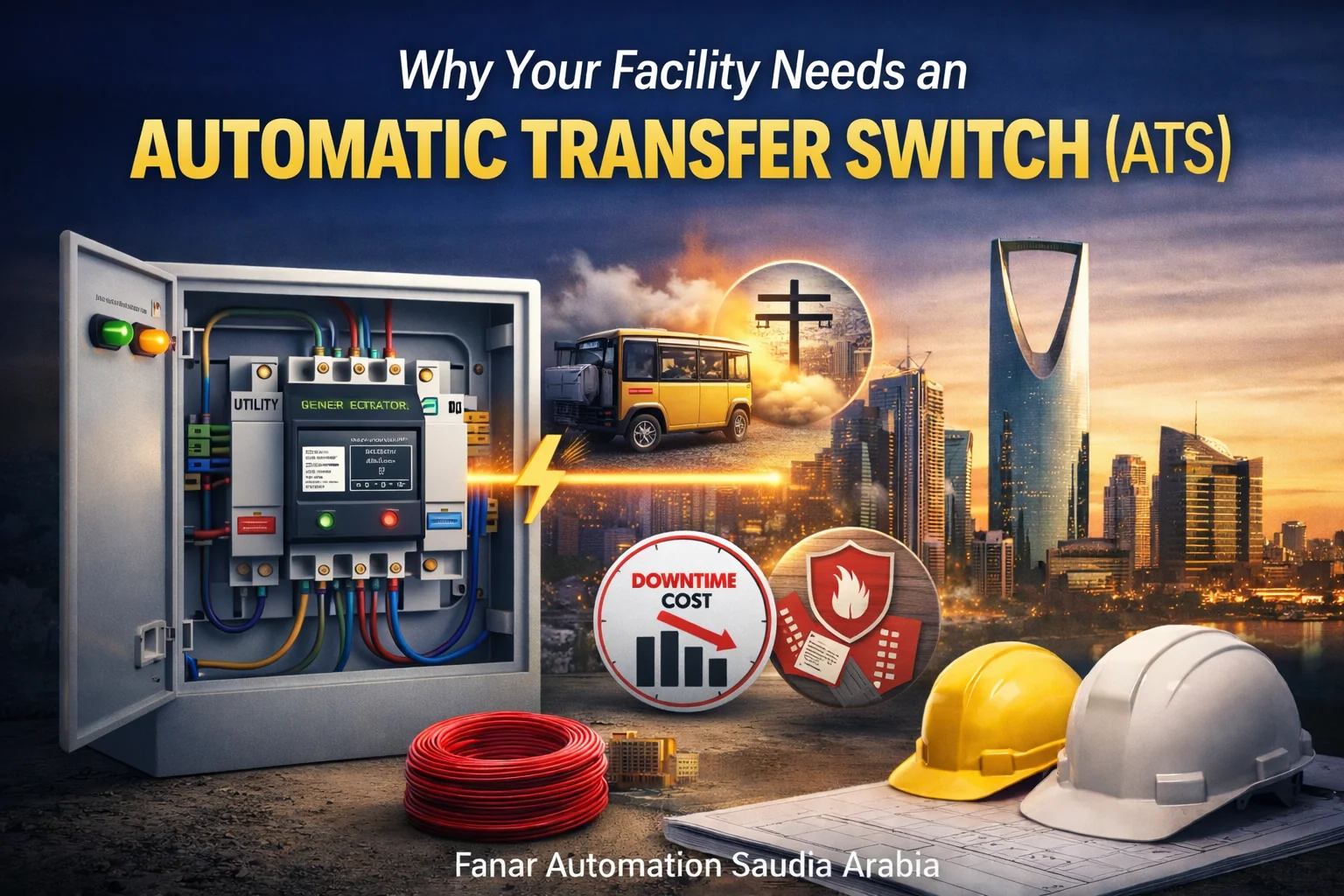
Let me explain it simply. An Automatic Transfer Switch is an intelligent electrical device which will change your power supply between the main utility supply and a backup generating device the second it notices a failure. No manual switching. No scrambling in the dark. Once the grid power is restored, it automatically turns off. It is similar to having a standby driver who is willing to take over the wheel the moment the primary driver loses the control. Smooth. Fast. Controlled. In a plant where power count is in seconds, not in minutes, such speed is not convenient, but essential.
Downtime Isn’t Just Annoying. It’s Expensive.
Consider a production plant in which machines abruptly go dead halfway through their work. Production halts. Materials waste. Deadlines slip. Or imagine a business structure with the lifts breaking down and occupants being deprived of lights and air conditioning. During Saudi summers, air conditioning is not only an inconvenience to lose, it is also a hassle.
Disruption of power may cause:
- Equipment damage
- Data loss
- Revenue loss
- Safety risks
- Tenant dissatisfaction
and reputation loss may be worse than repair expenses.
An ATS minimizes those risks. It maintains operations even in the face of the unforeseen.
How Does an ATS Work?
This leads to a situation in which the company, in its official capacity, opted to follow the verified methods of producing and marketing products rather than taking the obvious course to create new ones.<|human|>It results in the fact when the company in its formal capacity chose to adhere to the tested ways of creating and selling products instead of the obvious way to develop new ones.
The utility voltage is constantly monitored by an ATS.
If it detects:
- Voltage drop
- Complete outage
- Frequency irregularity
It gives a signal to the generator to start. The switch switches the load of the utility to the generator within seconds. When the primary supply has become steady, the ATS switches the power back and closes the generator in a safe manner. It is easy to say–and to do. Behind that simplicity, however, is skillful engineering, due size, and due installation.
Saudi Facilities are presented with Special Demands.
The Saudi Arabian business and industry is expanding at a high rate. There are new industrial areas, megaprojects, commercial complexes, it is an active world.Growth, however, comes with the increased energy demand.
The facilities which will get the most out of ATS systems are:
- Hospitals and clinics
- Data centers
- Manufacturing plants
- Commercial towers
- Hotels and malls
- Cold storage warehouses
You know what?
Even those facilities who believe they do not really need backup are in many cases found regretting that decision once they have experienced their first major outage.
Generator Alone Isn’t Enough
The one most frequently used myth is as follows: we have already had a generator, and we are insured.
Not exactly. In the absence of an ATS, a person will have to manually turn the switching between the main supply and the generator. That delay can take minutes. Sometimes longer.
And during that gap?
Systems shut down. of sensitive equipment that can be affected by power interruptions are VFD-controlled motors, or industrial control panels. That is where an ATS comes in to fill that gap. It integrates automatically with your backup source. In Fanar Automation, it is common to find that the plant has a generator, but there is no transfer system. The difference in operational stability is self-evident as soon as the latter is installed properly.
How to select the Right ATS in Your Organization It is not a One-Size-Fits-All Process.
Not all ATS units are equal. Capacity, type of switching and load category are important.
You’ll need to consider:
- Total load capacity (amps rating)
- Single-phase systems or three-phase systems.
- Open transition switching or closed transition switching.
- Cooperation with distribution boards that are in place.
- Generator compatibility
- Oversizing wastes budget. Undersizing creates risk.
The evaluation of the correct load calculations and system analysis is needed in that balance. It is not a trial and error project. Fanar Automation offers low and medium voltage electrical construction products available in Saudi Arabia as well as professional installation services to guarantee the successful integration into your facility into the existing system.
Installation More Than You Think.
At best, an ATS is as good as it is installed. Nuisance tripping may occur due to improper wiring, improper cable sizing, or poor panel integration, which can result in system failure in case of emergency situation.
This is why the services should be comprehensive:
- Cable Installing Services.
- Electrical Panellations Services.
- VFD Repairs Services
All these contribute to having a stable power ecosystem. Weaknesses could be caused by installing an ATS without updating the electrical panel, when the electric panel is old. All things have to collaborate. System design (in isolation) provides stability.
The reasons as to why Facilities Trust Fanar Automation.
When you share partnership with Fanar automation, you are making a decision based on experience in the real operating conditions of the Saudi.
The company offers:
- The quality of ATS and electrical solutions.
- Commercial and industrial building installation Specialty installation.
- Quick services throughout Saudi Arabia.
- High quality products constructed using quality materials.
In Fanar Automation, quality and stability is all there is. The team has many years of experience in electrical installation, repairs, and upgrading, which is why they are able to offer long-term solutions, as opposed to quick solutions. Equipment is not the only thing required in facilities. They should be assured that the system can perform when required.
Concluding Ideas- Stability Is Smart Business.
An Automatic Transfer Switch is not glamourous. It doesn’t attract attention. The point is, most of the time, you will forget that it is even there. And that’s the point. In case of power failure, your plant will not go down. Lights stay on. Machines keep running. Air conditioners whimper in the background.
No panic. No scrambling.
The power cuts are not a luxury in the fast-paced commercial and industrial environment of Saudi Arabia, but rather it is the security of operation. In the event that your facility relies on reliable electricity, and most do, implementing an appropriate-designed ATS via a reliable solution provider like the Fanar Automation is a feasible solution to long-term stability.