
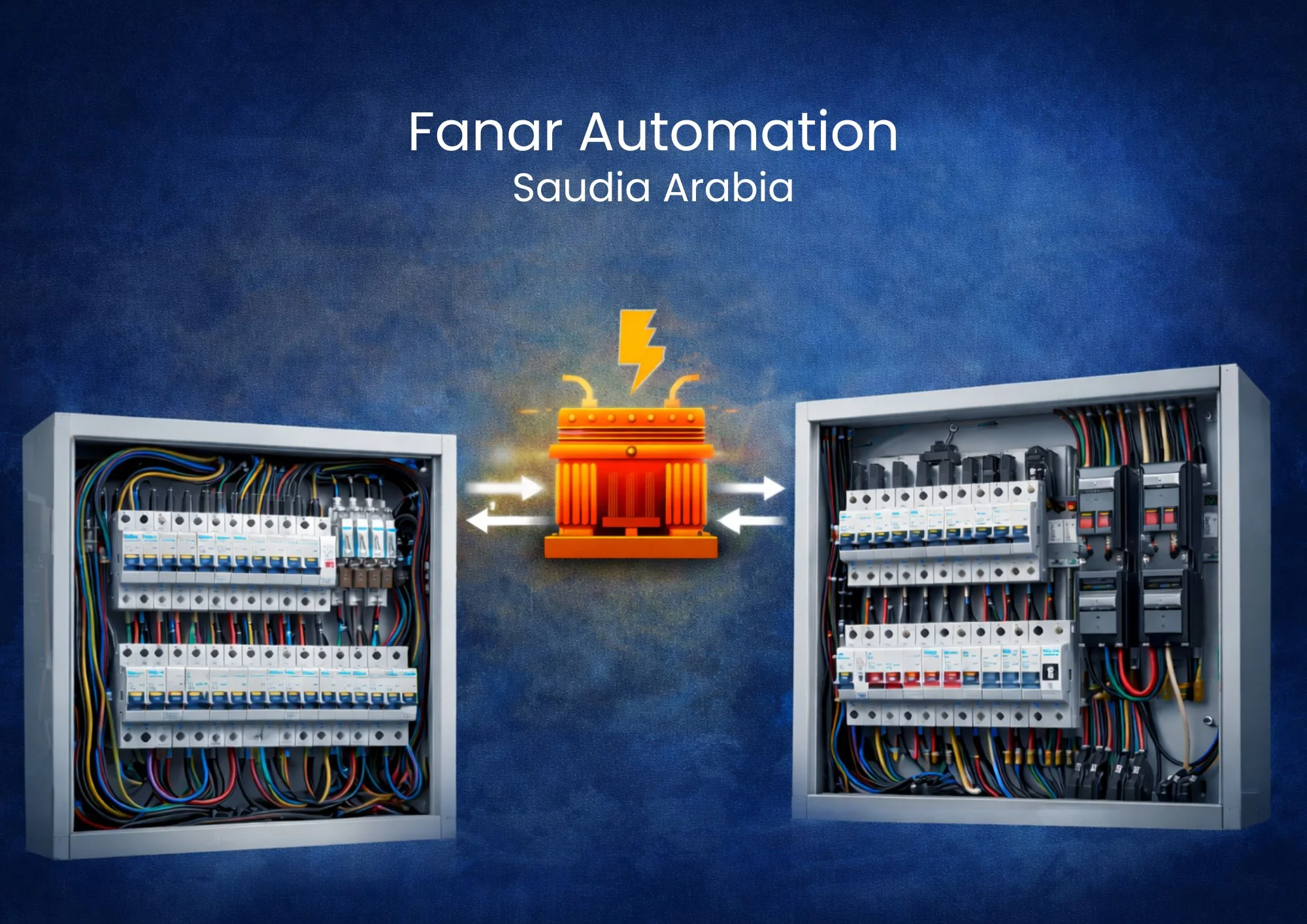
Everything uses electricity, including the light and HVAC systems, and the heavy industrial equipment. There is, however, a vital element behind all the safe and efficient electrical installation that many people do not give much thought, the distribution board.
Were you ever confused by the question, What is the difference between a main board and a sub-board? or How does power get distributed safely across a facility?–this guide will take you on a tour of the very structure of a distribution board system.
As a facility manager, electrical contractor, or project consultant in Saudi Arabia, it will be important to know the difference between main distribution boards (MDBs) and sub-distribution boards (SDBs) in terms of safety, scaling, and compliance.
What Is a Distribution Board?
A distribution board (DB) (also referred to as a breaker panel or panel board) is the junction of a distribution where electric power is split into subsidiary circuits. It delivers electricity in a safe manner and safeguards circuits by use of breakers or fuses.
Distribution Board has the following core functions:
- Being supplied with incoming power.
- Breaks up power into lesser circuits.
- Barricades against overload and short circuits.
- Gives isolation and control.
- The distribution board is simply put the traffic controller of your electrical system.
The Main Distribution Board (MDB): The Central Control Station.
The central part of an electrical system is the Main Distribution Board (MDB). It is that panel which is fed directly by the transformer or utility connection.
- The important features of an MDB:
- Handles incoming large capacity power.
- Has primary circuit breakers.
- Supplies power to sub-boards
- Metering and monitoring systems are included.
- Houses are often provided with surge protection devices.
The MDB is normally mounted in a separate electrical room in a commercial or industrial setting to offer convenience and safety.
Why the MDB Matters ?
- If the MDB fails, the entire facility loses power. This is why its design, installation, and maintenance require expert-level precision.
Sub-Distribution Boards (SDBs):
Localized Control of Power. MDB controls power distribution generally but Sub-Distribution Boards (SDBs) control departments or areas of a building. Just imagine the MDB as the main highways and the SDBs are the secondary roads that lead to particular neighborhoods.
Key Features of Sub-Boards:
- Get authority at the head office.
- Allot electricity to particular areas.
- Control localized circuits Reduce wiring complexity Enhance safety division.
- Sub-boards are used to distribute electrical systems efficiently and safely in large facilities; factories, hospitals, shopping malls.
Why Proper Distribution Board Design Is Critical
- The improperly developed system of distribution may result in various acute issues:
- – Overloaded circuits
- – Frequent breaker trips
- – Equipment damage
- – Fire hazards – Costly downtime
Even in industrial environment, a simple breakdown of the electrical system can stop production lines and incur major losses.
Actionable Tip:
Prior to the installation or a distribution board system upgrade, the following steps need to be considered:
- – Conduct a professional load test.
- – project expansion requirements.
- – Check the IEC standards and local electrical code.
The Interior Constitution of a Distribution Board.
Knowing what is in a DB will reveal its technical sophistication.
- Core Components:
- Main Breaker- Disconnects the whole panel.
- Busbars – Conduct current in the board.
- Circuit Breakers (MCBs/MCCBs) -Protect individual circuits.
- Residual Current Devices (RCDs) – Avert electric shock.
- Surge Protecting Devices (SPDs) – Protect against voltage surges.
- Neutral and Earth Bars – Grounding.
Recommended Visual Element:
Include an infographic showing a labeled internal layout of:
-
Busbars
-
Breakers
-
Neutral bars
-
Ground connections
Predominant Installation errors to be avoided.
Even the seasoned installers may miss out on important details.
1. Excessively Paneling or Under-paneling.
The excessive system consumes resources. A small system results in congestion.
2. Poor Cable Management
Poor cable routing may result in over heating and inconvenient maintenance.
3. Overlooking Future Load Expansion.
There is a growth in modern facilities and your distribution board must increase in line with this growth.
4. Inadequate Ventilation
Overheating decreases the life of equipments.
Distribution Boards in Business and Industry.
The distributor boards used in commercial buildings should be able to provide:
- HVAC systems
- Elevators
- Lighting networks
- Data centers
- Security systems
The requirements are more complex in an industrial setting:
- Heavy machinery
- Automation systems
- Motor control centers
- Variable frequency drive (VFDs).
That is when professional skill plays a crucial role.
In Fanar Automation innovative solutions are offered to all the electronic failures. The company provides low- and medium-voltage electrical construction products and services to satisfy the needs of commercial and industrial applications in Saudi Arabia; it ensures that the system is efficient, scalable, and meets regional standards.