
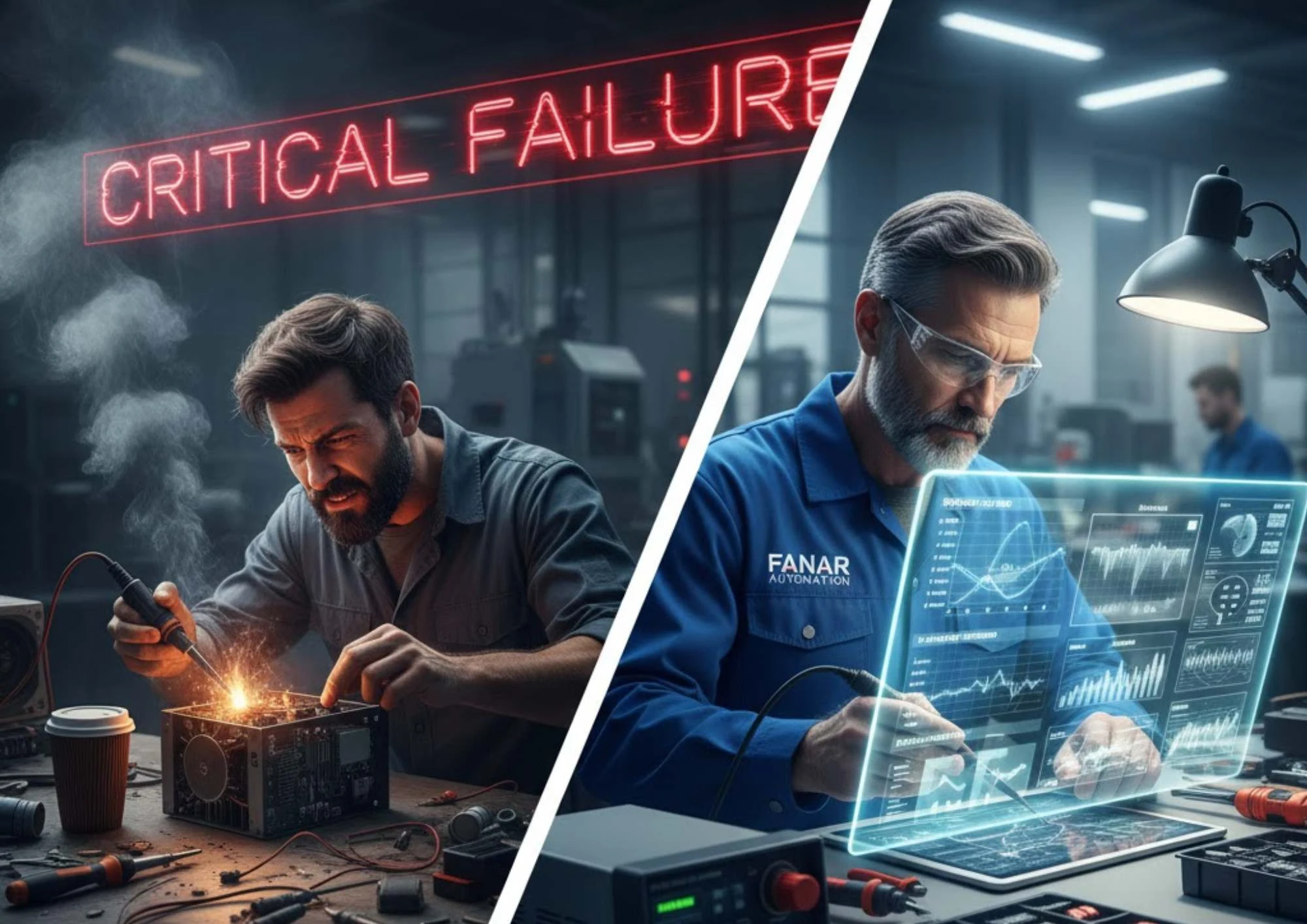
A Variable Frequency Drive (VFD) malfunction in the hectic industrial environment can cause manufacturing to come to a crawl. The immediate reaction could be to introduce a fast in-house solution to fix the situation and reduce the downtime. Although the self-reliance spirit is admirable in this case, VFDs are much more seriously impacted by this DIY quick-fix culture, which may cause even greater issues, expensive failed attempts, and even risk of accidents in the long run.
The fact is VFDs are complex power electronics. Their accurate functioning needs special knowledge, diagnostic equipment, and careful observance of details when repairing them. Herein lies the significance of precision engineering and expert VFD repair services including the services provided by Fanar Automation.
The Allure of the DIY Quick-Fix (and its Hidden Dangers)
It is not difficult to guess why a DIY strategy may be attractive:
- Perceived Cost Savings: It has been perceived to be less expensive to replace a seemingly defective parts such as a capacitor or IGBT module within the company rather than to have a professional repair or replace the part.
- Minimized Downtime (Short-Term): It does not take long to get the VFD “running” again, even temporarily, which may feel like winning.
- Convenience: It is a hassle to transport a unit to repair or to wait until an external technician comes.
But these perceived advantages tend to obscure great underlying dangers:
- Misdiagnosis: In the absence of specialized diagnostic equipment and training, it is very difficult to determine the underlying cause of a VFD failure. Some fault code may represent an “overcurrent, yet the real issue could be a failed gate driver, a broken motor, or even a momentary power transient. A replacement of one of the parts without correction of the cause will ensure that a second failure does occur.
- Component Incompatibility: VFDs incorporate particular components, which may be proprietary, that have to be of high specification in voltage, current, temperature and switching speed. Off the shelf, non-specific components may cause instant failure, cause poor efficiency or even cause damage to other drive components.
- Collateral Damage: The failure to follow the correct instructions when repairing, soldering incorrectly, or even accidentally shorting a part during a DIY project can cause damage to other healthy parts of the parts making a small repair project into a huge disaster.
- Safety Hazards: VFDs are designed to work on large voltages and currents and when turned off, capacitors can retain unsafe residual charges. When not handled properly it may cause severe electrical shock, burns or arc flashes.
-
Absence of Calibration and Testing: A VFD does not merely involve replacing parts, but one must also calibrate and test it thoroughly under load conditions to make sure it is operating within specifications. A home-repair does not have this important validation. Voided Warranties: In the case of trying to do unacceptable repairs, any remaining warranty by the manufacturer is normally nullified, denying you the ability to sue later.
The Professional Advantage: Precision, Expertise, and Long-Term Reliability
Professional VFD repair services offer a stark contrast to the quick-fix approach, prioritizing precision, expertise, and ultimately, long-term reliability.
Advanced Diagnostics and Root Cause Analysis
Special diagnostic instruments, oscilloscopes, megohmmeters and thermal imaging cameras are provided to professional technicians. They do not merely substitute a broken part: they do:
- Extensive Component Testing: Individual component testing This is done on all critical components, including power modules (IGBTs, diodes), capacitors and control boards to define real causes of failure.
- Thermal Analysis: Thermal analysis is used to detect hotspots in the system, which can reveal the presence of malfunctioning components, or even a defective design.
- Waveform Analysis: Waveform, with oscilloscopes, is used to analyze voltage and current waveforms at different points to identify small irregularities which cannot be detected with a multimeter.
- Root Cause Investigation: This is the process of knowing the cause of failure of a component. Was it old age or did it reflect some underlying problem such as poor power quality, motor problems or a stressful environment? Correction of the cause of failure aids in averting a repeat failure.