
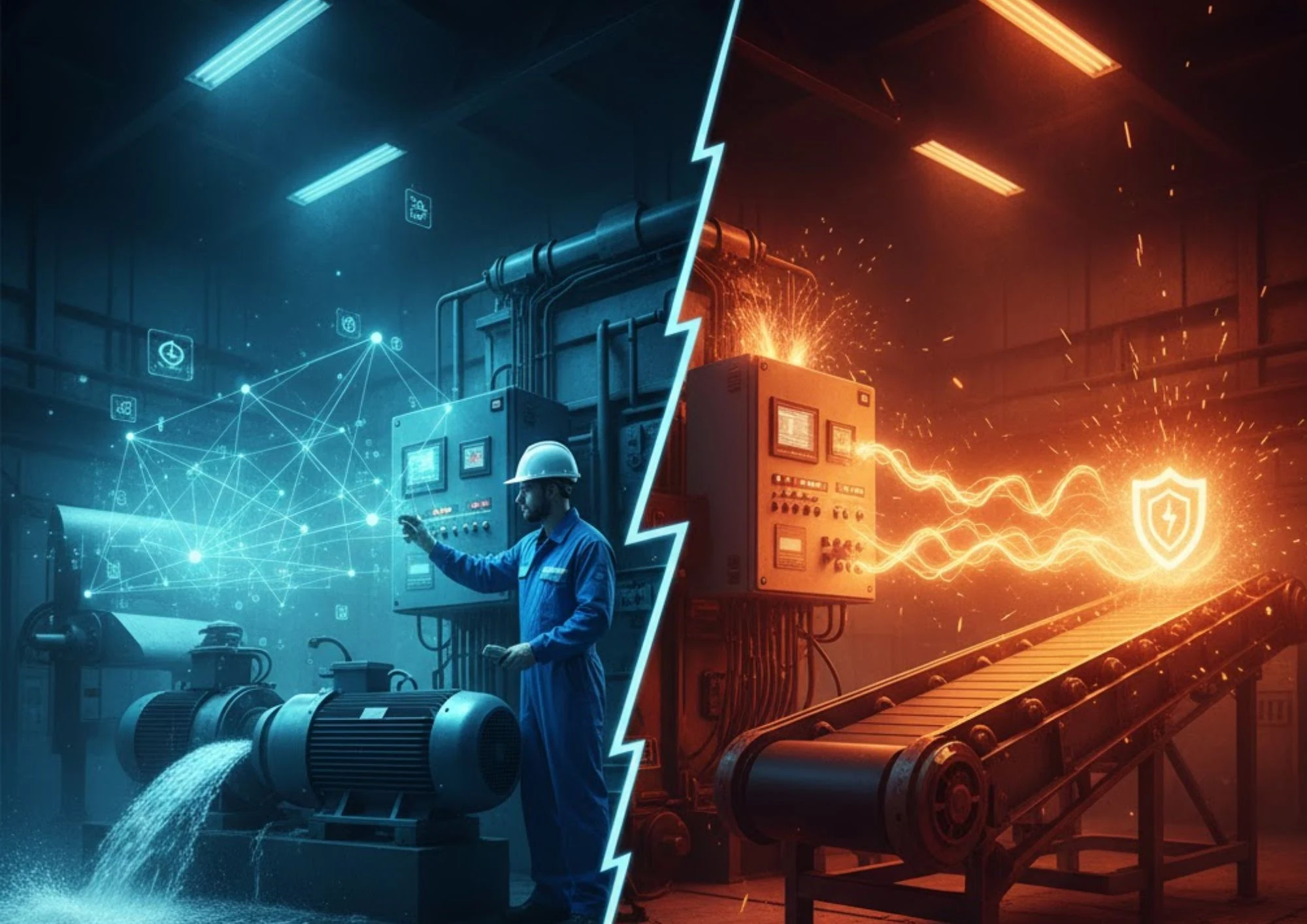
VFD vs. Soft Starters Which Solution should you use in your business infrastructure
VFDs and Soft Starters: What Are They and What Do They Do?
It is important to first understand the functionality of each device before indulging into head to head comparison.
What is Variable Frequency Drive (VFD)?
A Variable Frequency Drive /Variable speed motor, sometimes called an Adjustable Speed Drive (ASD), inverter, is a power electronic device that can regulate the speed and torque of an AC induction motor by adjusting the frequency and voltage of the electrical energy feeding the motor. A VFD enables a motor to run at any speed required, as well as to zero speed and higher speed to its rated maximum speed, or even higher.
Key Capabilities of a VFD:
- Variable Speed Control: Adjusts motor speed to match process demand.
- Soft Start/Stop: Ramps the motor up and down smoothly, preventing mechanical shock and electrical stress.
- Energy Savings: Particularly in variable torque applications (fans, pumps), significant energy savings are achieved by reducing speed.
- Torque Control: Offers precise control over motor torque.
- Power Factor Correction: Improves the overall power factor of the motor.
What is a Soft Starter?
A Soft Starter is a solid-state device that gradually ramps up the voltage to an AC electric motor during startup. Its primary purpose is to reduce the mechanical stress on the motor and connected equipment, as well as mitigate the high inrush currents typically associated with direct-on-line (DOL) starting. Once the motor reaches full speed, many soft starters will bypass their internal electronics to minimize heat generation and power losses.
Key Capabilities of a Soft Starter:
- Variable Speed Control: This is the control that should also be used to adjust the speed of the motor according to demand of the process.
- Soft Start/Stop: The motor will be brought to a gentle start and Smith also to a gentle stop to avoid mechanical shock and electrical stress.
- Energy Savings: In applications which require variable torque (fans, pumps), a dramatic saving of energy is realized by slowing down the machine.
- Torque Control: Provides accurate control of motor torque.
- Power Factor Correction: Enhances the total power factor of the motor.
VFD vs. Soft Starter: A Detailed Comparison
We shall consider the differentiating factors between these two technologies in motor control that are critical.
Primary Functionality
VFD: Range of control of speed and torque. Its main advantage is the possibility to operate continuously and adjust it.
Soft Starter: This type is mainly used to turn a motor in and out at a constant working speed.
Energy Efficiency
VFD: Saves a lot of energy when it is important (i.e. variable torque) particularly in fans, pumps, compressors, etc. where speed reduction greatly reduces power use (because of Affinity Laws).
Soft Starter: Saves little or nothing in terms of energy during continuous operation at full blast. It has an energy advantage in that it lowers peak demand charges when starting up.
Application Suitability
VFD: Suited best to job descriptions with a need of accurate speed, process control, flow/pressure or energy saving. These are HVAC systems, pumping stations, conveyor belts with different loads, and extrusion machines.
Soft Starter: This type is the most appropriate in the practice when the motor is used mainly at full load nevertheless, it does not need to start with high power and it is necessary to provide soft start to prevent mechanical parts damages or to prevent high load on the electric power. These are constant speed pumps, crushers, mixers and the large fans which do not require speed control.
Cost
VFD: More expensive to buy at the start because it has more complicated electronic parts and has wider functionality.
Soft Starter: This is usually cheaper than a VFD of a certain motor size, because the operation of this starter is more restricted.
Complex and Installation.
VFD: It is more difficult to install and commission, and the parameters must be carefully adjusted to achieve optimal performance over a range of speeds. Needs to be EMI/RFI filtered and cable-wise.
Soft Starter: Easier to install and set up, and mainly concentrates on the start/stop parameters.
Motor Protection
VFD: Is a very high-protection motor with a wide range of monitoring functions, such as overload, overvoltage, undervoltage, short circuit, ground fault, and even thermal simulation of the motor.
Soft Starter: Provides strong motor protection, primarily centered on overcurrent, phase loss as well as thermal overload at startup and running.
Harmonic Distortion
- VFD: May re-introduce the harmonic distortion into the power supply, which may necessitate further harmonic control measures (e.g. line reactor, filter) based on the power quality needs of the facility.
Soft Starter: There is generally not much harmonics distortion with sustained full-speed operation, but some harmonics may be created during the soft-start process.
In order to know which one between a VFD or a soft starter would be superior, consider the following questions:
- Is a Variable Speed Control Necessary?
When your process requires specific control of motor speed, flow, pressure, or temperature (i.e. fan speed to ventilation requirement, pump speed to liquid demand), a VFD is absolutely essential.
A soft starter may be adequate, provided that the motor is started at full speed, and that it is not necessary to control the speed. - What Does Your Energy Saving Goal?
A VFD returns better ROI over significant, sustained energy savings especially in a fluctuating load application (variable torque).
In case the energy saving is mainly because of the need to avoid peak demand charges when starting the motor this may require a soft starter that is affordable. - Your Budget and ROI (Expected)?
Take into account the overall cost of ownership, i.e., initial purchase, installation, and long-term energy savings. Although a VFD may be more expensive to purchase initially, its energy savings can have a shorter payback period. - The importance of Equipment Longevity?
The two devices prolong the life of the equipment by minimizing mechanical shocks. Nevertheless, VFDs will provide a more sophisticated degree of control over the entire operating range, which may have even more long-term mechanical advantages. - What are the Power Quality Requirements of Your Facility?
In the event that a significant threat is the harmonic distortion, you will be required to incur extra mitigation expenses of VFDs. It is important that your power infrastructure should be assessed professionally.
Ideal Applications for VFDs:
HVAC systems (fans, blowers)
- Pumps (water, wastewater, chemical) of different flow demands.
- Conveyor systems that need to be adjusted in speed to allow products to flow.
- Extruders and mixers in which the speed can affect the consistency of the material.
- Machine tools (lathes, mills) that need specific RPM.
Privilege Uses of Soft Starters:\
- Big fans or pumps which are usually on at one constant rate.
- Where a smooth start is required to prevent belt slip, or mechanical stress, crushers, grinders or saws.
- To minimize pressure peaks, compressors (reciprocating) are used.
- Where this is an issue to the electrical grid, any application where high inrush current is a problem.
Collaboration with Fanar Automation to get the Right Solution.
The selection of motor control device is a very important choice which influences all your operation. At the Fanar Automation, we are aware of the specifics of industrial infrastructure in Saudi Arabia.
Our highly qualified personnel will offer a full-blown consultancy, in which they assess your applications, energy objectives and your budgetary limits to offer as well as select the best solution, which may either be a VFD a soft starter or a blend of the two. We make sure that the solution you get is not only technically competent but also that it meets the local requirements and that it is in line with your long term objectives of running.
Closure: Peak Performance Governance.
Variable Frequency Drives and Soft Starters have their place and use in the world of motor control, differing in their purpose. Although a soft starter is a good choice of a starter to keep your equipment safe during startup, a VFD has unmatched accuracy in load control during continuous processes and achieves a high energy savings in a flexible process.
Through thorough consideration of your applications requirements, your budget, and long-term efficiency targets, you are able to make a wise choice that brings productivity, creates a longer life span of equipment and adds up to a greener and economical operation.